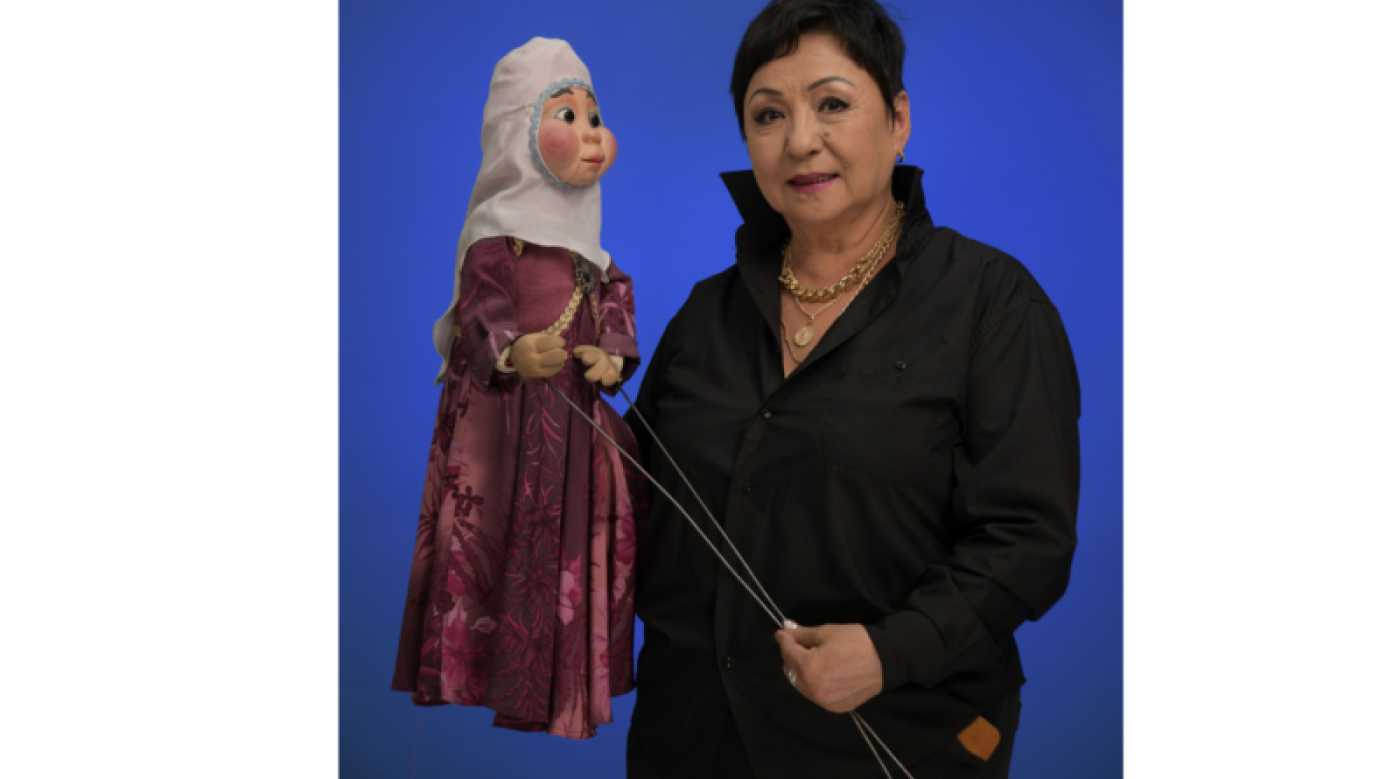
Here is the full, natural English translation of the interview:
– We know you well as a veteran artist whose life and творчество have been inseparably connected with puppet theater for many years. Looking back and comparing the day you first came to work in the theater with today, how, in your opinion, have the stage and the audience changed?
– If I look back and compare the past with the present, I would say that the most important thing in theater is the human being, and essentially, people do not change. Eras change, technologies evolve, forms of communication and the pace of life shift, but the inner nature of a person remains the same.
Some people remain children at heart—open, trusting, and full of light. Others, on the contrary, carry resentment, disappointment, and fatigue within them. And all of this comes into the auditorium with them. That is why I always say: we should not think that people radically change over time. Only the outer shell of the world changes, not its inner essence.
A child, however, is a special state of being. It is a blank page not yet filled with life experience. And our task is not to spoil that page, but rather to carefully and gently inscribe kindness, honesty, empathy, and the ability to understand others onto it. Because that is what becomes the foundation of a future personality.
– Over your many years in puppet theater, you have interacted with thousands of young viewers. Is there a particularly sincere reaction or touching moment that still warms your heart and reminds you why this art exists?
– Over the years, there have been many trips, tours, and meetings with children in all kinds of places—large cities and small villages. Sometimes we would travel for a long time, for a month or even longer. And I always noticed: children are the same everywhere in their sincerity.
A child’s sincerity does not depend on place, language, or living conditions. They respond with their hearts—directly, honestly, without filters. And that is what makes a young audience both the most challenging and the most honest.
I also remember myself as a child. When I was in the 4th or 5th grade, a theater came to our school and performed “The Scarlet Flower.” For us, it was a real miracle. We watched in awe, not understanding how a fairy tale could come alive right before our eyes.
Years later, fate brought me together with those same people on the same stage. In moments like that, you realize that theater is not just a profession, but a special life path that connects generations.
But if we talk about the strongest impressions, it is probably not about isolated “shocking” moments, but about a constant sense of responsibility. Because a child leaves the theater not just with emotions, but with inner experience. And it is we, the artists, who shape that experience.
We are not just performers—we are, in a way, second teachers. We give children their first understanding of good and evil, justice, and compassion. And we truly hope that after a performance, something more than just impressions remains—a quiet inner movement toward goodness.
After the pandemic, it became especially noticeable how much people missed live art. Theater once again became a place of meeting, communication, and breathing. And this is a very important sign: a human being still needs another human being.
– What has inspired you, again and again, to remain devoted to puppet theater and your art? How do you avoid burnout?
– Burnout is a natural condition that everyone faces. It is part of human nature, and it cannot be denied. But the profession of an artist carries a special responsibility: you do not go on stage alone, but to meet the audience, who came for emotion, experience, and meaning.
At that moment, you do not have the right to remain in your personal state. There is an unspoken rule of the stage—to leave everything behind the curtains: pain, fatigue, anxiety, even illness.
There have been times when I had to go on stage with a high fever because the hall was already full and the audience was waiting. In those moments, you realize that theater is not about comfort—it is about responsibility and respect for the audience.
I often compare our profession to the work of a chef. The audience sees only the finished dish—beautiful, refined, well-presented. But they never see the process: the fatigue, the burns, the tension, the search. The same is true in theater. We do not show what happens behind the scenes. We present only the result—a living action, emotion, an image. And perhaps that is where the magic of art lies.
And inspiration… it comes from the process itself. From the audience’s reaction, from the silence in the hall, from the eyes of children who believe in what is happening. That is what brings you back to the stage again and again.
– You have acted in films, worked as a voice actress, and performed in puppet theater. Are there differences? What is the challenge?
– In art, everything is interconnected. You cannot divide the acting profession into isolated parts—everything overlaps and complements each other.
Cinema, theater, and voice acting are simply different forms of existence of the same person in art.
Cinema has a certain rigidity of the moment. You play a scene once—and it remains forever. There is strength and responsibility in that, but also difficulty. You cannot redo it later, correct it, or add something. The camera captures everything, and that moment becomes part of history.
The theater, on the other hand, is a living fabric. Every performance is a new experience. You can feel the role differently, live through the scene in a new way, add new shades. Theater lives and breathes together with the actor.
I have participated in various projects, including the films “My Name is Kozha Too,” “Wounded Feeling,” “Nauryz.kz,” “Wedding at Any Cost,” “Urban Legends,” and “Aisha.” I have also done voice acting—from Japanese cartoons to fairy-tale characters like Baba Yaga.
But puppet theater is a special world. It is a synthesis of everything: voice, body, breath, music, movement. A puppet comes to life only when the actor puts their soul into it.
And perhaps that is why puppet actors are so versatile. We know how to be different, because we are used to bringing life to what is lifeless.
– What advice would you give to the younger generation entering the path of art?
– The most important thing is not to be indifferent to the learning process. You cannot simply “be present” in class—you must absorb every opportunity, every observation, every remark.
Each teacher has their own school, their own perspective, their own truth. And it is important to take from each what can enrich you as an artist. Art is constant accumulation, inner work that never ends.
If you have chosen this profession, you must love it. Otherwise, it will become heavy and empty. There are no случайные people on stage—you can always see who truly lives this art and who is merely present.
Go to theaters, watch performances, observe actors. Learn not only from teachers, but also from colleagues and masters of the stage. Analyze, discuss, compare. This shapes your artistic taste and professional thinking.
It is also very important to work on your technique—diction, breathing, voice, movement. In the past, actors performed in huge halls without microphones, which required incredible strength and endurance.
But most importantly—do not lose a living connection with art. Because theater exists only as long as there is sincerity in it.
– Thank you very much for your time and for such a sincere and warm conversation.
Akbope Kopbai