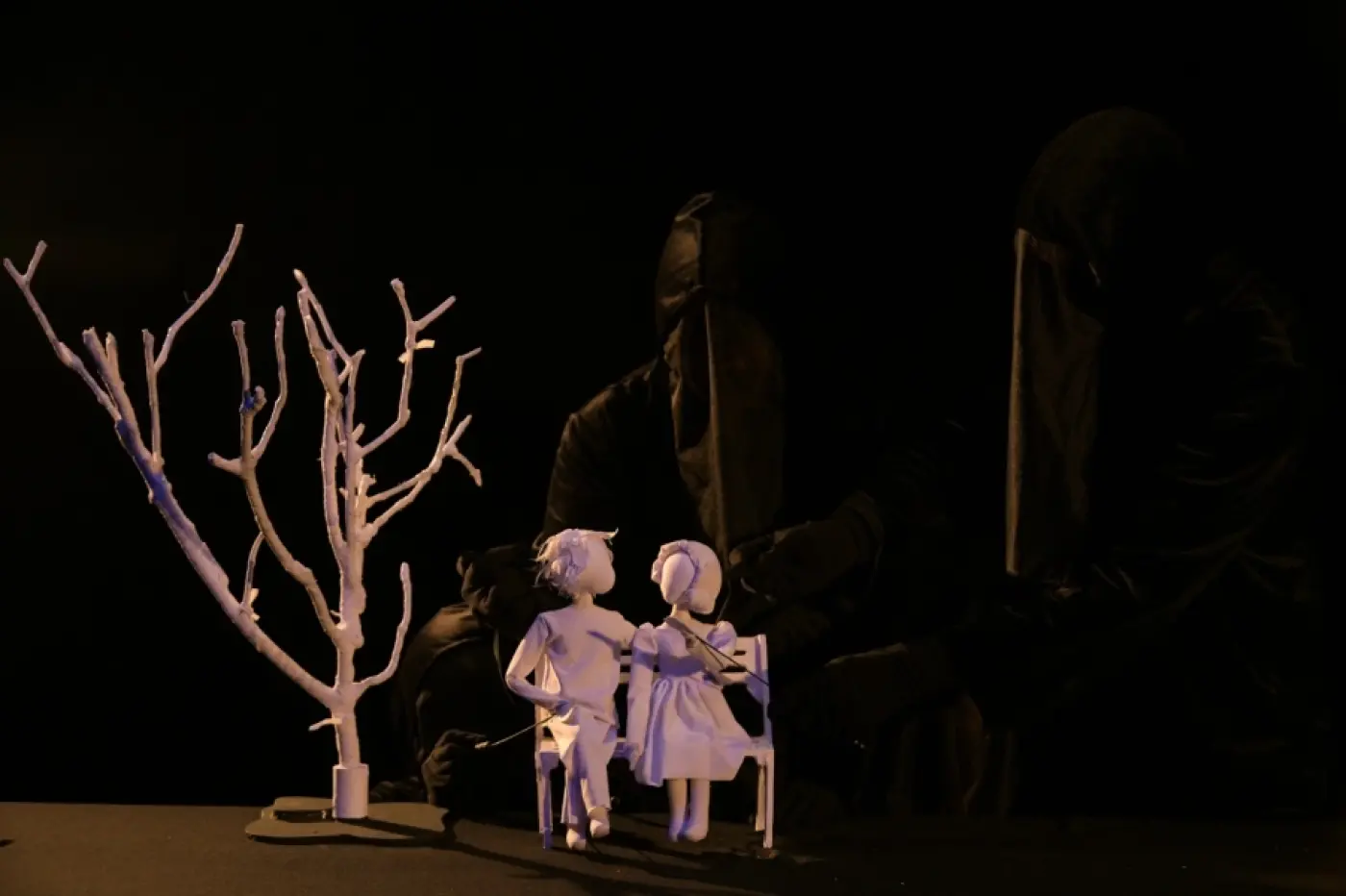
On the stage of the State Academic Puppet Theatre in Almaty, the production of Georgian director Nikoloz Sabashvili’s “Без лица” (“The Maskless”) was once again presented. The performance explores the limits of human kindness and the tragedy of losing one’s own “self,” turning into a profound philosophical reflection for the audience.
Sometimes theatre ceases to be just a stage—it becomes a space of inner experience, where the viewer no longer merely observes but lives through what is happening. This is precisely the kind of experience offered by the State Academic Puppet Theatre’s production “Без лица” by Georgian director Nikoloz Sabashvili, once again presented to the Almaty audience. The performance leaves behind not so much a plot as a state of being—quiet, unsettling, and lingering long after it ends.
Sabashvili’s name is already familiar to Kazakh audiences. His “The Overcoat”, staged in 2024 at the State Academic Puppet Theatre, and the recent premiere “Men” at the Kostanay Regional Puppet Theatre testify to the director’s constant interest in liminal human conditions—where conventional morality breaks down and the fragility of the individual is exposed. In these works, he explores not events, but inner fractures through which human essence seeps out.
“Без лица” continues this trajectory, but does so in a more intense and symbolically rich form. At the center of the story is a person almost devoid of resistance to the world. He is not merely kind—he is растворён (dissolved) in his kindness, as if in endless acceptance of others’ desires. He lets a stranger into his home, believing him to be a messenger of light, and opens not only the space of his dwelling but also the space of his own life.
And at that moment, an imperceptible disappearance begins. First, the home vanishes—as a foundation. Then love—as warmth. Then the loyal dog—as the last form of devotion. And finally, something even more subtle and irreversible disappears—the sense of one’s own “self.” The stranger does not simply take; he erases, and this erasure happens almost routinely, without external violence, as if the hero’s very kindness gradually turns against him.
The performance unfolds as a metaphor of dangerous self-sacrifice, where the pursuit of goodness loses its boundaries and turns into self-destruction. Here arises an important question with no simple answer: does virtue remain virtue if it destroys the one who carries it?
The climax arrives not as an explosion but as accumulated silence that can no longer be contained. The killing of the stranger becomes not merely an act, but a rupture in the hero’s inner fabric. It is neither victory nor liberation—rather a desperate gesture of a person who has long ceased to exist as a subject. Thus, violence here is not a point of resolution, but a continuation: a cycle in which pain inevitably returns to its source.
A particularly powerful impression is created by the scene with white faceless masks. In their cold symmetry there is something disturbingly familiar—like a collective breath of thoughts that belong to no one in particular. The whisper of the masks sounds like the inner noise of consciousness, where the boundaries between fear, guilt, and imposed roles dissolve. At this moment, the hero seems to disappear completely—not physically, but ontologically, vanishing as a unique personality.
The finale of the performance is perceived both as a premonition and as a surprise. It is emotionally logical and yet subverts audience expectations: kindness pushed to its extreme turns into vulnerability, and vulnerability becomes tragedy. This contradiction forms the core tension of the production.
Musical elements and subtle religious echoes form a separate layer. They are not explicitly stated, but are felt as the background of an inner dialogue between a person and themselves. They reinforce the sense that what is happening on stage is not the story of one individual, but a reflection on human existence as a whole.
“Без лица” remains after itself not as a performance, but as a trace. A quiet reminder that the boundaries between goodness and self-erasure are dangerously thin, and that the loss of one’s “face” begins long before the reflection disappears.
Kopbai Akbopе.